A damp patch near a chimney breast gets blamed on “the chimney” almost automatically. However, the causes behind it are quite specific, and each one has a different fix. Working through them in order usually narrows it down fast.
Failed flashing
This is the most common cause by a distance, since the lead flashing sits right in the weather’s path. It bridges the gap between brick and roof covering at the base of the stack. If it lifts, cracks, or was poorly fitted, water tracks straight down inside the chimney breast. It no longer runs off the roof as it should. Failing flashing is consistently cited as the leading cause of chimney leaks. It’s often made worse over time, too, as the surrounding mortar erodes and stops gripping the lead properly.
Fix: re-dressing or replacing the lead flashing, and re-pointing the joint it sits in if the mortar has degraded.
Cracked flaunching (the mortar cap)
Flaunching is the sloped mortar cap on top of the stack. It’s moulded around the base of the chimney pots so rainwater runs off rather than pooling. It sits fully exposed at the highest point of the roof. That exposure makes it prone to hairline cracking, which widens over repeated freeze-thaw cycles until water gets straight down into the stack.
Fix: raking out and re-forming the flaunching in fresh mortar — usually a same-day job unless the pots themselves need resetting.
Porous or eroded brickwork
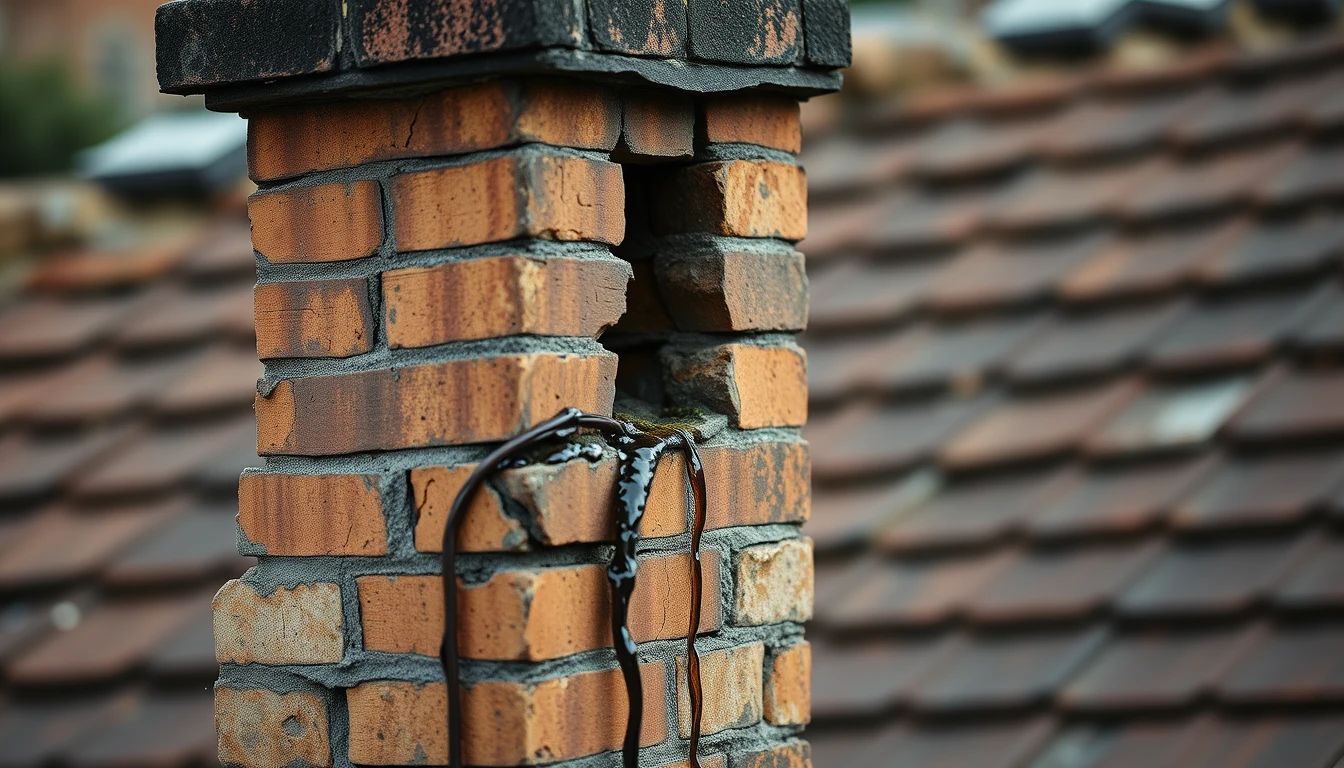
Brick is naturally slightly porous, and that’s usually fine. It stops being fine once the mortar joints between bricks erode. Water then gets past the surface and starts tracking through the wall itself. This is more of a slow-building problem than the other causes. It tends to show up as damp that gradually worsens over a season. That’s unlike a leak that appears suddenly after one storm.
Fix: repointing the eroded joints, and in more severe cases a breathable masonry treatment on older, softer brick.
Missing or damaged chimney cowl, or a failed DPC
If the flue is unused or only used occasionally, rain can fall straight down the open pot with nothing to deflect it. A properly fitted cowl solves this, and it’s particularly worth considering on flues that aren’t in daily use. Separately, chimneys have their own damp-proof course (DPC) built into the brickwork a little above roof level. It stops moisture that does get in from tracking down into the room below. Where that DPC is missing, damaged, or was never fitted correctly, damp can appear well below the actual leak. That’s exactly why a leak “from the chimney” doesn’t always show up near the roofline at all.
Fix: fitting a suitable cowl for the flue type, or installing or replacing a chimney DPC where it’s missing.
Is it actually the chimney, or the roof around it?
This is worth ruling in or out early, since the fix is completely different. A leak that’s genuinely chimney-related tends to track down the chimney breast itself, inside the room, roughly following the line of the flue. A leak actually coming from the roof covering nearby is different. Think a cracked tile in a valley next to the stack, or a saddle behind the chimney that’s blocked or corroded. That kind often shows up as damp on the ceiling near the chimney, rather than on the breast wall. A proper inspection from inside the loft is the only reliable way to tell the two apart. It traces the water back to its actual entry point.
If you’ve got a damp patch and you’re not sure which of these it is, get in touch. We offer chimney repairs and we’ll trace the cause properly rather than guessing. Our guide to chimney repointing and leadwork explains the two most common jobs behind these fixes in more detail.
Why guessing gets expensive
It’s tempting to have the pointing redone as a first move, since it’s a visible, affordable job that feels like doing something. The problem is that fresh pointing does nothing if the real cause is a failed cowl or a missing DPC. The damp keeps coming back, and now there’s also a bill for work that didn’t fix the underlying issue. Chimneys often have more than one thing wrong at once, too, particularly on older stacks that haven’t been checked in years. As a result, a leak can persist even after one genuine cause has been properly fixed, simply because a second cause was never addressed.
A proper diagnosis usually starts from inside the loft, tracing the damp back along the timber and felt to its actual entry point. That gets checked against what’s visible on the stack from outside: the flashing, the flaunching, the brickwork and the cowl or pot. Since it’s done once properly, that sequence is almost always cheaper than repairing each element in turn on a guess.
What a typical fix looks like in practice
Most chimney leaks resolve with one of these, sometimes two together:
- Re-dressing or replacing a section of lead flashing, alongside repointing the joint it sits in
- Raking out and re-forming cracked flaunching on the chimney cap
- Repointing eroded brickwork on the stack itself
- Fitting a cowl to an underused flue, or installing a DPC where one is missing
None of these are large jobs individually, and most are completed in a day once access is arranged. The time worth spending is on confirming which one, or which combination, actually applies before work starts.
If the leak looks more urgent than expected, our guide to what to do when your roof is leaking covers the immediate steps. This rundown of what counts as an emergency roof repair explains when emergency roof repairs beat a scheduled visit.
It’s also worth having a wider check done while access is arranged. Our guides to roof inspection frequency and safe moss removal both cover maintenance that catches problems early. Similarly, if the leak’s been running a while, check your gutters too. Overflow near the stack can sometimes mimic a chimney leak.
Wokingham’s older housing stock
Wokingham has plenty of Victorian and interwar housing with original brick chimney stacks. Many have had years of pointing, flashing and flaunching cycles layered on top of each other by different contractors over time. That history makes a proper diagnosis even more worthwhile before starting any repair. What looks like a flashing problem can sometimes be a DPC that was never fitted when the house was built. The same applies in nearby Maidenhead, where similar period housing carries the same layered repair history. If you’re in Wokingham and dealing with a chimney leak, it’s worth having someone trace it properly rather than repointing on a guess.
Get in touch and get a free quote — we’ll have a proper look and tell you plainly what’s actually causing it.